New model releases, new integrations, new platforms. The announcements have been coming weekly for months. Every week brings something promising to change how you work.
Most of it is noise for a small business.
Not because the tools are bad. Some of them are genuinely useful. The problem is that adding tools to a broken sequence makes the sequence faster at producing the wrong result.
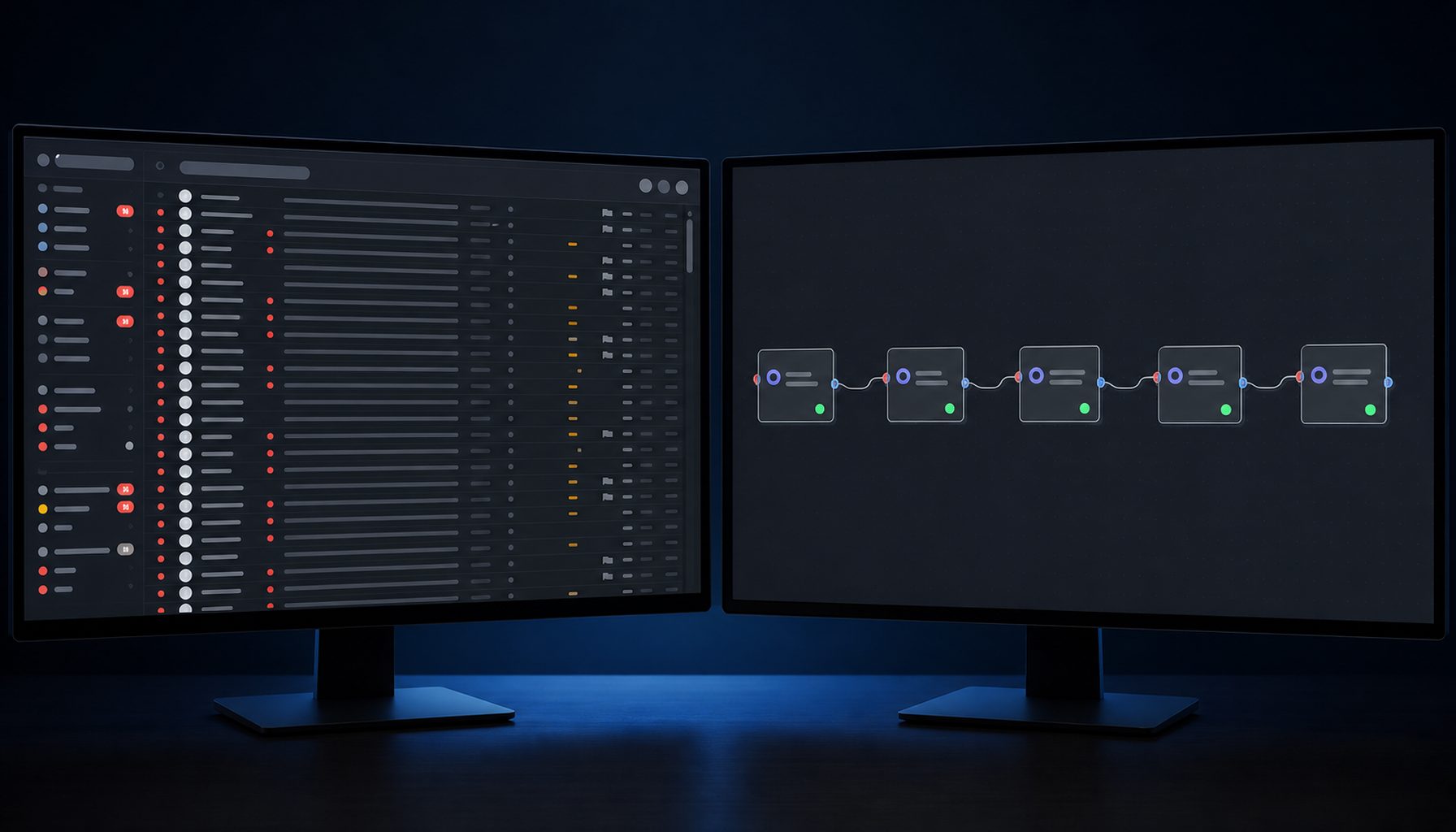
The Sequence Problem
A workflow is a sequence of decisions and actions. Each step takes input, does something with it, and passes the output to the next step. If the sequence is well-designed, the result is reliable. If the sequence is poorly designed, the result is unpredictable regardless of how good the individual tools are.
Most small business automation problems are sequence problems, not tool problems.
An email arrives. It needs to be read, categorized, and routed. The routing decision depends on the category. The response depends on the routing. Each of those steps requires a decision. If the decisions are not defined clearly, no tool can make them reliably. Swapping in a better model does not fix a categorization scheme that was never thought through.

Email triage: how a well-designed sequence routes every category, escalating the ones that need a person.
What to Do Instead
Map the sequence before you build anything. Take one process, a specific, recurring task, and walk through every decision point. What triggers it? What information does each step need? What are the possible outcomes? Where do exceptions go?
Most processes that feel complicated turn out to have three or four decision points. Most of those decision points have rules that can be written down. Once you have the rules written, the right tool to execute them is usually obvious.
The businesses that get the most value from AI tools understood their process first and chose tools to execute it. The tool serves the sequence. The sequence serves the outcome.
A Practical Test
Before adding any new tool or platform, answer this: what specific decision in your current sequence will this tool make more reliably? If you cannot answer that in one sentence, the tool is not the right next step.
The sequence is the thing. Get that right and almost any tool will work. Get it wrong and no tool will save you. Then, call Agent Micho.
Sources
- The sequence design argument, the email sorting example, and the diagnosis of tool sprawl come from client work and from our own operations.
- The claim that businesses getting the most from AI tools understood their process first is an argument from experience, not a measured result.
- n8n is the orchestration layer. The email sorting diagram illustrates the logic rather than a specific client build.
A note on images across this site. Illustrations and workflow diagrams are made with AI, from prompts we write and refine, and we edit most of them afterwards. Screenshots taken in n8n are not, since they show workflows we built in the tool.