The most common question I hear before a project starts: how much time will this actually save? It is a fair question, and the honest answer is that it depends on what you are automating and where your time is going right now. The examples below are from systems I built and ran. The numbers are real.

A Content Brand: From Six Hours to Thirty Minutes
The Society of Scents and Spirits runs across Instagram and a weekly newsletter. Before automation, the publishing workflow looked like this: write the content, reformat it manually for each platform, enter it into scheduling tools one by one, update a shared editorial calendar, and then do it all again the following week. That process was taking six hours a week before a single word of new content was created.
I built an automated pipeline that takes a single content brief and handles the rest. The brief gets formatted for each platform automatically, scheduled at optimal posting times based on historical engagement data, and logged in the editorial calendar without any manual entry. The whole weekly workflow now runs in under thirty minutes. The five-plus hours recovered go directly into content creation and audience engagement.
The second part of that system is a Monday morning idea generator. Every Monday, a formatted batch of post ideas lands in the inbox, tailored to the brand's niche, audience profile, and what has performed well in the past. Each idea includes a suggested caption angle, content format, and hashtag clusters. Content planning time dropped by roughly 70 percent. The blank-page problem is gone.
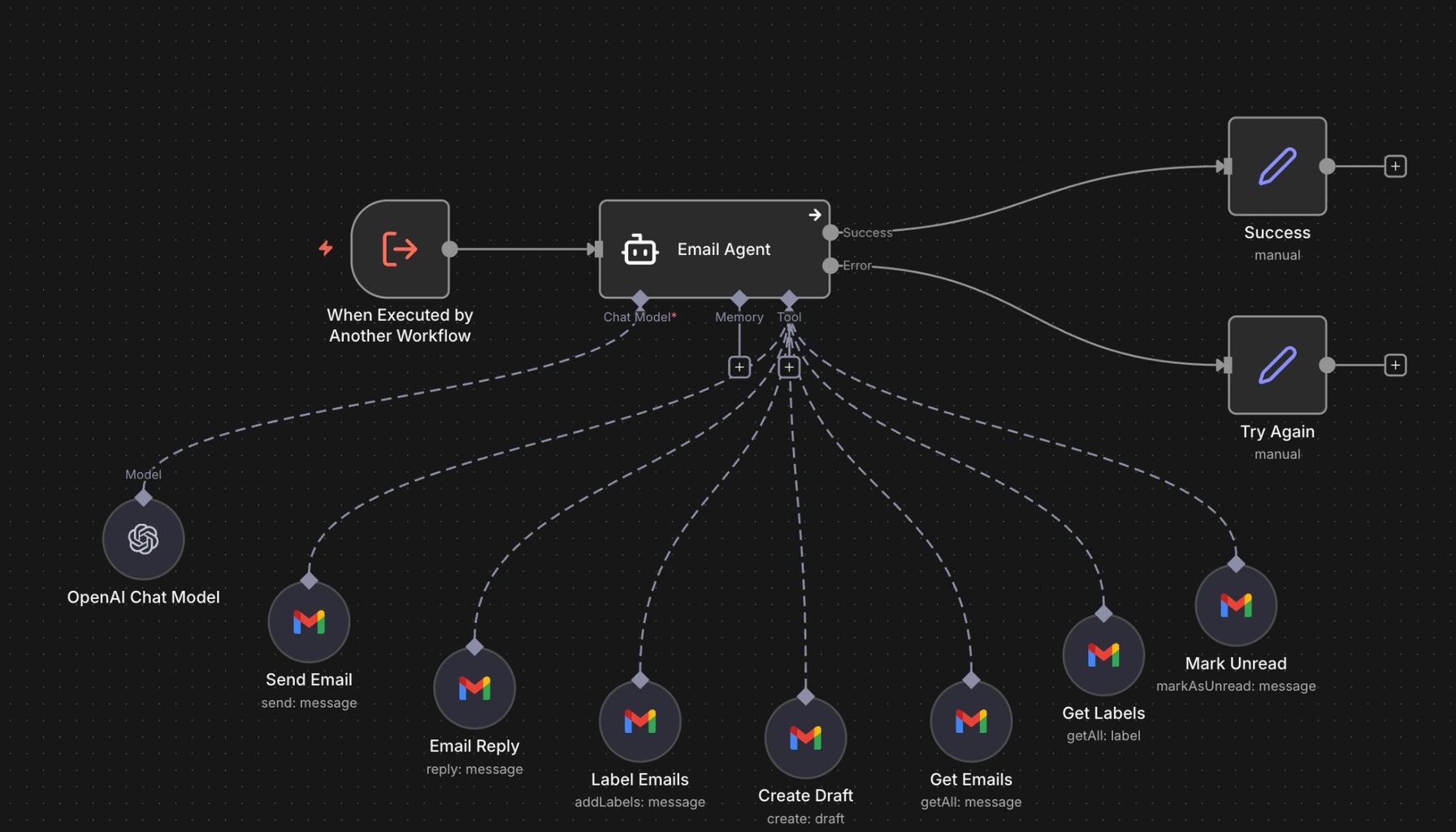
A Service Business: Ten Hours a Week on Invoicing and Email, Now Near Zero
A home services business was losing repeat customers not because the work was bad, but because nobody followed up. Jobs were completed, clients were satisfied, and then silence. When follow-ups did happen, they were inconsistent and late. Invoices were being sent manually, and chasing overdue payments was a weekly drain.
I built a post-job automation that triggers as soon as a job is marked complete in the business system. A personalized thank-you goes out that same day. A review request follows three days later, timed to land when the client has had a chance to use the work but the experience is still fresh. After thirty days of inactivity, a re-engagement message goes out asking if there is anything else on their list. No promotion, no discount, just a reminder that the business exists and is available.
Invoice generation was automated alongside the follow-up sequence. The invoice fires when the job is marked complete. Payment reminders go out automatically at day ten, day twenty, and day thirty if the invoice remains unpaid. The business runs 18 to 24 jobs a week across six days, and each invoice was taking about twenty minutes to prepare and send, so invoicing alone was costing six to eight hours a week. Email handling was another four hours on top of that. Both are now near instantaneous. Average payment collection time improved by twelve days.
Two things came out of it that the hours do not capture. Billing had been a mix of paper and card, and consolidating it to card meant every payment landed in the same place and got logged without anyone retyping it. And the person who had been doing the invoicing got the better part of a day back each week, which went into work that needed a person.
A Real Estate Agent: Response Time from Hours to Seconds
A solo real estate agent was losing leads because she could not respond quickly enough. New inquiries from listing sites were sitting in her email for hours before she saw them. By the time she responded, the lead had often already spoken to another agent. Being second is nearly the same as not responding at all.
I built an instant lead response system. The moment a new inquiry comes in, it triggers a personalized acknowledgment that goes out within seconds. The message references the specific property the lead inquired about, confirms availability, and asks one qualifying question about timeline and budget. Leads are then scored automatically by urgency and property interest, and high-priority leads are flagged directly to her phone so she can follow up personally within minutes.
Her response rate in the first month improved significantly. She attributes two closed deals in the first quarter directly to leads she would previously have lost to competitors who simply replied faster. The automation did not replace the relationship. It made sure the relationship had a chance to start.
A Product Database: Three Hours a Week, Now Zero
A luxury fragrance collector and content creator was maintaining a database of over 750 fragrances by hand. Adding new items, logging reviews and ratings, updating sourcing information, and keeping notes current was taking three hours per week and still falling behind. The database was becoming unreliable, which made it useless as a content planning tool.
I built an automated ingestion pipeline that captures new entries from multiple input sources, applies consistent formatting and categorization rules, and writes directly to the master database. New acquisitions are logged within minutes of being added to the source. Reviews and ratings update automatically as they are recorded. The three hours a week dropped to zero. The database is now current, searchable, and reliable.
The system also feeds a content suggestion workflow that draws from the database to generate post ideas based on what is seasonally relevant, what has not been covered recently, and what has driven engagement in the past. The collector went from spending time maintaining the database to the database actively supporting her content operation.
What the Pattern Looks Like
Across these examples, the pattern is the same. Find the tasks that are high-volume, low-judgment, and repeatable. Build a system that handles them consistently. Measure what changes. In every case the time recovered was measured in hours per week, which adds up to days per month and weeks per year.
The other thing these examples have in common: none of them required a technical background to understand or request. They required someone to describe what they were doing manually today, and someone else to build a system that did it instead.
If any of these sound like your week, get in touch and I will work through what the numbers could look like for your business.
The Infrastructure That Makes Consistency Possible
One pattern across every example above is that the automation did not create the capability. It made the capability consistent. The home services business already knew how to follow up with clients. The fragrance creator already knew how to write assessments. The real estate agent already knew how to qualify leads. What the automation did was remove the dependency on memory, availability, and energy that made all of those things inconsistent.
This is the distinction worth holding onto: automation does not replace skill or judgment. It removes the operational friction that prevents skill and judgment from being applied reliably. The thank-you email gets automated because writing a good one at the end of every day, to every client, without ever forgetting, is more than anyone can sustain. The automation makes the human's intention reliable.
The same applies to the data entry examples. The collector's assessments of 765 fragrances are deeply personal and require years of developed taste to produce. None of that is automated. What is automated is the pipeline that ensures every assessment ends up in the right place, in the right format, connected to the right metadata. The human produces the value. The automation ensures the value is preserved and accessible.
When you are deciding what to automate in your business, the useful frame is not "what can a computer do?" It is "what is the gap between what I intend to do for every client and what I actually manage to do consistently?" That gap is almost always the right target. And closing it almost always produces measurable results quickly.
The through-line in every example above is that the automation did not create the capability. It made the capability consistent. The businesses involved already knew how to follow up, how to send invoices, how to respond to leads. What they lacked was a system that ensured those things happened reliably, every time, regardless of what else was going on. You still have to know what good looks like. Automation is the mechanism that delivers it without depending on memory, energy, or a quiet day.
What all of these numbers point to is something simple: the cost of not automating is real, ongoing, and rarely visible until you stop to measure it. Every week that passes without a follow-up sequence is a week where some clients who would have returned did not. Every week of manual data entry is a week where errors accumulate in systems that everything else depends on. The investment to fix these things is bounded. The cost of leaving them is not.
Building automation is about making sure the human element shows up reliably. The follow-up that gets sent, the invoice that goes out, the record that gets updated: none of it is impressive, and all of it is foundational. Automation makes them happen without depending on a person to remember, to have time, or to be having a good day. That reliability is the foundation everything else is built on.
See this in practice: Content Creators use case →
Sources
- Every figure in this piece is measured on a specific client engagement or on our own operations. None of it is survey data and none of it is an industry average.
- The home services business: 18 to 24 jobs a week across six days, roughly twenty minutes per invoice to prepare and send, so six to eight hours a week on invoicing alone, plus about four hours a week on email. Average payment collection time improved by twelve days. An earlier version of this post put the combined follow-up and invoicing time at four hours a week, which understated it by more than half.
- The six-to-eight-hour invoicing figure is arithmetic from the job count and the per-invoice time rather than a stopwatch measurement. Both inputs are estimates from the engagement.
- The content brand figures, the fragrance database at three hours a week, and the roughly 70 percent drop in content planning time are measured on Society of Scents and Spirits.
- The real estate agent's two closed deals in the first quarter is her attribution, not a controlled measurement. An earlier version of this post also claimed the first agent to respond wins the client roughly 78 percent of the time in residential real estate. That figure is attributed to a different origin by every source carrying it, all of them vendors selling response-time software, and it has been removed.
- The fragrance collection figure moves as the collection grows.
A note on images across this site. Illustrations and workflow diagrams are made with AI, from prompts we write and refine, and we edit most of them afterwards. Screenshots taken in n8n are not, since they show workflows we built in the tool.